Valley Friends Meeting celebrated its fifth anniversary of becoming a solarized faith community on October 14, 2023. They accomplished this by a roof-mounted, 10.5kw, 34-panel array financed through a Power Purchase Agreement (PPA). In those five years, the array has produced 65 megawatt hours and saved 100,000 pounds of CO2, the equivalent of 760 trees planted, according to the metrics at the SolarEdge website. Prior to the installation of the solar array, they replaced a 60-year-old oil furnace with a high-efficiency heat pump. The combination has saved Valley Friends Meeting approximately $1500 annually in utility bills. Moreover, the heat-pump provides air-conditioning to the Meetinghouse in summer months, which was not previously air-conditioned. It is gratifying that doing the right thing for the climate can also be the wise thing to do. For more information, contact Dave Pruett at, c.david.pruett@gmail.com
HMC Announcements: Tree Project Update
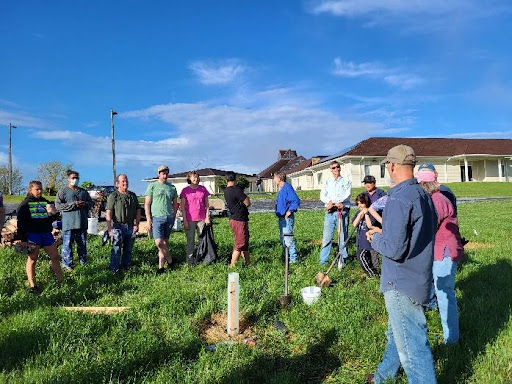
On April 15, the Harrisonburg Mennonite Church congregation planted over four hundred trees on the church grounds as a project to create a Garden of Trees on the hilltop campus. The workday brought together congregation members, including youth, community members, and community children, of the Wednesday evening ‘Kids Club.’
HMC responded to the MCUSA Mennonite Men’s JoinTrees initiative and received a grant to launch the project. MCUSA JoinTrees Initiative aspires to plant 1 million trees in this decade. More information on the initiative can be found at this link: JoinTrees (mennonitemen.org)
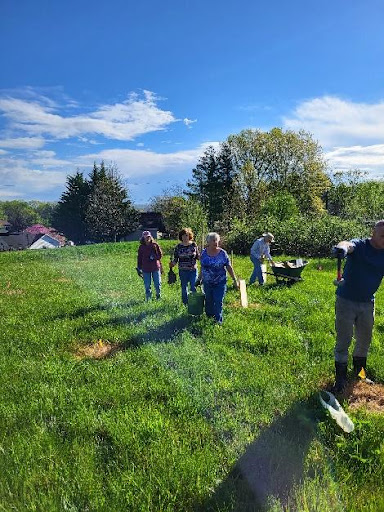
The HMC tree planting goals are to create a bio-diverse campus of native plants, reduce fossil fuel consumption from lawn mowing, create a place for prayer, meditation, fellowship, and land recreation, sequester carbon and mitigate surface water runoff, trap and increase soil moisture retention for the benefit of the community environment.
Despite a dry summer, a high percentage of the trees are thriving and beginning to grow out of the tree protectors. The non-survivors will be replaced in the fall. Though it may appear to be close spacings, the trees are placed in clusters of tree varieties, including understory trees and bushes, to create a wide variety of colors, pollinators, and wildlife food. The varieties include; yellow poplar, red maple, red, white, and chestnut oaks, shortleaf and Virginia pines, black gum, sweet gum, paw-paw, persimmon, locust, American plum, hazelnut, dogwood, redbud, buttonbush, indigo bush, serviceberry and bald cypress.
The project received strong interest from the city of Harrisonburg’s Conservation Assistance Program (HCAP) and the Shenandoah Valley Pure Water Forum (SVPWF) to enhance the city and the region’s environmental quality goals. HMC received its second grant award, $1000 from the SVPWF to be a model project in Harrisonburg. A third grant from HCAP is expected for the next phase to include a native meadow.
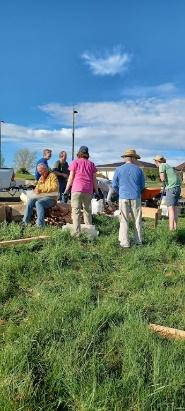
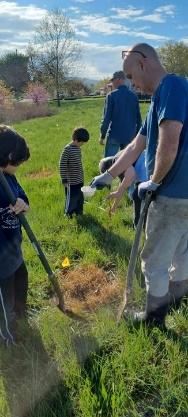
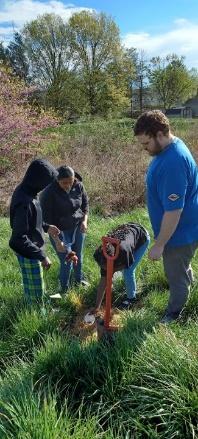
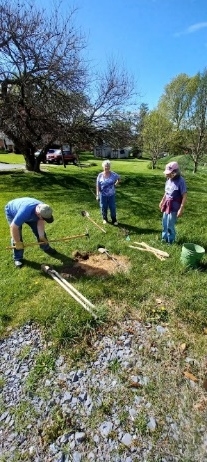
The HMC Creation Care Group assists the congregation in meeting its stewardship goals, including care for God’s Creation, and hopes to collaborate with local businesses and residents to enhance the community environment. The CCG will be preparing for phase II, a second planting day in the fall. This is who we are!!
Contact person: Loren Hostetter (hostetterla@yahoo.com)
Harrisonburg Mennonite Church Solar Panel Project
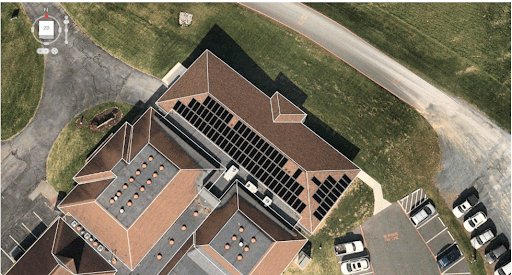
On April 20, 2022, Harrisonburg Mennonite Church (HMC) switched on a roof-mounted, 87-panel, 37 KW solar photovoltaic generator. This system provides roughly one-third of the church’s annual electricity demand. In the first 17 months of trouble-free operation, the system generated about 80 MWh of electricity, saving the church nearly $9,000 in electric bills. This system’s zero-emission electricity production reduced the church’s carbon footprint by some 60 tonnes of CO2, roughly equivalent to planting about 1,000 trees.
Years ago, the first attempt to install a solar power system at HMC did not go well. Disagreements arose, opposition became vocal, and the project was scrapped. A second attempt was made a few years later. Before beginning the new project, those involved in the first attempt were interviewed—both for and against the project. It became clear that communication problems contributed to the lack of success on the first attempt.
Based on these findings, a Solar project team was formed, and a constituency model for the project development was established. Four stakeholder groups were identified: Pastors/Elders, Creation Care, Buildings and Grounds, and the Church Council. As the project proposal proceeded, all four stakeholder groups were kept in the conversation process. Each group’s support was gained before moving to the next step. The Pastors/Elders group was responsible for the project aligning with the church mission. The Creation Care group promoted the reduction of the church’s carbon emissions. The Building and Grounds wanted a trouble-free system, and the Church Council wanted an economically feasible one. Once complete alignment was achieved, the final project proposal was presented to the congregation for their support, along with a fund-raising presentation.
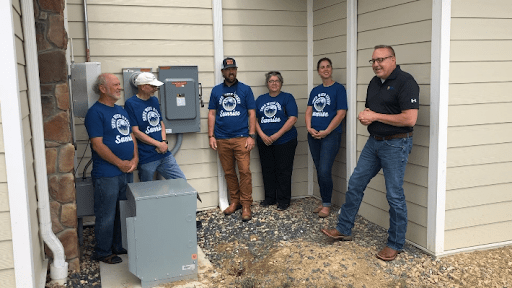
The project development process team followed a stepwise approach, gaining input and support from each stakeholder group. The strategic plan included a clearly defined vision, mission, and objectives. Many adjustments were made along the way. In the end, the final project was fully supported by all four stakeholder groups. This process took about one year from start to finish. Numerous vendors, equipment options, panel locations, economic evaluations, environmental impact analyses, and biblical principles of stewardship and justice were evaluated.
Congregation members were made “informally” aware of the progress during the project development process. There was a good bit of excitement and anticipation as the project proposal neared completion. The project proposal presented to the members included alignment with the church’s mission, the environmental benefits, the economic feasibility, and a vendor-technology option that provided performance guarantees, 10-year free service, and a 25-year warranty. The project was fully supported when brought to the congregation, and the fundraising was completed in 5 months. We came up with a “Buy-a-Panel” program. HMC members were given the opportunity to donate money to buy all or part of a solar panel. The goal was to raise the funds to purchase 87 panels.
It should be noted that the Inflation Reduction Act now allows nonprofits to claim a solar tax credit through direct payment. At the time of this project, nonprofits could not claim the tax credit. The church formed an LLC that purchased the panels, claimed the tax credit, collected the carbon credits, depreciated the asset, and collected a repayment revenue stream from the church. Once the solar asset is fully depreciated in year 6, the LLC will sell the system to the church at roughly one-half the original installed cost.
For more information, contact Steve Pardini, at pardini.steven@hotmail.com
A Model for Congregational Political Action
The following offers some guidance for congregations wanting to engage their members in a specific political climate action to reach out to elected officials. The guidance is only that; it is not prescriptive. We believe a concrete example will be helpful to understanding the steps shown below:
The Example
We documented these steps following a session at Shalom Mennonite Congregation, initiated by one of its pastors. It was preceded by an Earth Day/Month celebration plan. That plan included a service devoted to a focus on earth stewardship. The service was multi-generational and included stories and presentations for all ages. Congregants were invited to stay after the service, enjoy some pizza, and participate in a hands-on “action” activity. In preparation, Shalom’s pastor worked with volunteers from two local non-profit organizations, Climate Action Alliance of the Valley (CAAV) and Shenandoah Valley Faith and Climate (SVFC).
Together, these individuals researched and planned the event, identifying issues specific to the city and county in which Shalom’s congregants live and work. The pastor handled most of the logistics and the CAAV and SVFC volunteers developed the session agenda and the materials to be used. The materials included scripts for voice mails left for a local delegate and the Virginia Governor during the session; suggested language for use in postcards and letters to elected city and county officials; background information about the specific issues; and contact information for the officials.
There were approximately 50 individuals, including children and adults, who attended the session, which was planned for 1 ½ hours, including a pizza lunch. The session lasted just over the planned time. During the session, participants made phone calls and wrote postcards and letters. Some of the latter were given to the pastor for mailing; some participants chose to take their postcard or letter home to send directly.
The Model
- Step 1 – Plan a “working session” of congregants interested in climate action, sustainability, or resilience.
- Could be part of a series or a one-off.
- Could be an initial effort to inspire specific action or greater focus/participation among congregants.
- Could be family oriented or adults only.
- Consider timing around – e.g., specific season, Earth Day, congregational celebration, annual or long-range planning, upcoming event such as local elections
- Consider timing as to day of week, time of day, and connection to specific sermon or theme.
- Consider appropriate length of session(s).
- Determine availability of resources – e.g., space, amenities, seating, funding for food/drink/childcare (if necessary), and technology.
- Create invitation list and develop timetable for alerting and reminding congregants.
- Identify logistical support requirements and find volunteers to serve.
- Create and provide a schedule of session and assignments for all support personnel.
- Identify specific issues of local interest or importance.
- Prioritize issues.
- Decide on most appropriate issue(s) and desired outcome(s).
- Pull together, review, and develop an approach to providing relevant background information.
- Find subject matter experts within or outside congregation who can assist with materials development and be available during session to assist attendees.
- Determine attendee groupings
- Step 2 – Create the session agenda and materials.
- Consider the complexity of the issue and attendees to decide on presentation of both issue and background.
- Decide on proposed action item(s).
- Develop handouts and scripts, vetting with subject-matter experts and making enough copies for anticipated attendees.
- Obtain supplies for attendees’ use – e.g., pens, paper, postcards, and/or stamps, address/contact information for any recipients of action requests (e.g., public officials).
- Allow adequate time for attendee questions and responses to them.
- Identify a moderator and enough session monitors to ensure attendees’ needs/questions are monitored, identified timely, and addresses.
- Incorporate adequate time for initial socializing, food and drink, and additional break period(s).
- Develop a proposed follow-up plan for outreach to attendees and with any recipients of action requests from attendees (e.g., public officials), for review of effectiveness of action, and for next session(s) if appropriate.
- Step 3 – Conduct session.
- Try to stick to the agenda and schedule.
- Cover amenities early – e.g., food/drink, restrooms.
- Moderator should oversee to ensure attendee and volunteer needs are met.
- Attempt to gather from attendees prior to end of session their reactions and suggestions.
- Announce next steps, if any.
- Step 4 – Evaluate session.
- Follow-up with attendees about their experience and ask for their views on what worked well and not-so-well.
- Ask the volunteers for their assessments and recommendations for improvements/changes.
- Seek the views of the experts and presenters and ask for specific suggestions for improvements/changes.
- Revise steps 1 to 3 to address the responses.
- Incorporate the lessons learned into future session planning and events.
- Follow-up with attendees about their experience and ask for their views on what worked well and not-so-well.
For more information and advice on setting up this kind of Congregational Political Action event you can contact Joy Loving at: jal_1998@yahoo.com
Celebrating and Caring for Creation
Earth Day Sermon at Otterbein United Methodist Church, Harrisonburg, VA
Scriptures: Psalm 95:1-7; Luke 12: 32-34
It was a perfect day. The sky was bright and the trees formed a canopy overhead, shading me from the sun as I stood silently in the woods. I could hear the stream tumbling slowly across the rocks down below. In the tree above me, a spirited mockingbird was singing joyously. As in Wendell Berry’s short poem:
Best of any song
is bird song
in the quiet, but first
there has to be the quiet.
Then our hearts sing in tune with creation as we praise God our creator in unison with the Psalmist in our Scripture reading:
Let’s come into God’s presence with thanksgiving.
let’s shout for joy with songs of praise.
What I especially enjoy about being retired is beginning my day tending plants. Getting my hands dirty in my garden makes me happy. This most likely has roots in working in my traditional Mennonite mother’s garden when I was a boy. But I did lots of grumping about garden work back then.
My younger brother was excused from gardening because it made him break out in hives. How did he do that? I thought it was so unfair! So it has to be more than learning to garden at an early age. I recently learned that getting our hands in contact with soil bacteria triggers the release of serotonin in our brains, which boosts our immune systems and makes us happy.
Native American naturalist Robin Wall Kimmerer gave me a new insight into this in her book Braiding Sweetgrass. She writes, “Something essential happens in a vegetable garden. It’s a place where if you can’t say ‘I love you’ out loud, you can say it in seeds. And the land will reciprocate in beans.”
That’s why I love gardening. Digging into the damp, dark soil and getting that dirt under my fingernails puts me in touch with something that’s much bigger than I am. I can’t build vegetables and flowers like a carpenter builds houses. All I can do is plant, water, fertilize and then allow nature to do her work.
We’re part of an interconnected web of life. The following motto from the David Suzuki Foundation says it well:
We are the earth, through the plants and animals that nourish us. We are the rains and the oceans that flow through our veins. We are the breath of the forests of the land, and the plants of the sea.
We are human animals, related to all other life as descendants of the firstborn cell. We share with these kin a common history, written in our genes. We share a common present, filled with uncertainty. And we share a common future, as yet untold.
The Old Testament is full of creation stories. I chose the one from Psalm 95 for our worship service this morning because I want to emphasize praising our Creator God along with the rest of creation. What I especially like about the creation story in the first chapter of Genesis is the repeated refrain after each act of creation, “God saw how good it was.” I imagine our Creator standing back after each creative day and exclaiming, “Wow! That’s really good.”
It’s an expression of absolute joy in the wonder of it all. In this respect, love for all of creation and love for God are inseparable. We run into trouble when we separate ourselves from the rest of creation with disastrous consequences for the earth and ultimately for ourselves. This, in turn, separates us from God.
How do we explain our penchant for doing this? Perhaps greed but it has to be more. It’s easy to be driven by our anxieties and insecurities. Native American elders puzzled over the way European settlers randomly destroyed the land after they arrived. It was as though they still had one foot on the boat, and they didn’t know if they were staying or not. They feared the natural world in this abundant land and thought they had to bring it under control.
Jesus taught his disciples to not worry about their lives, what they will eat or wear. Such worries easily become destructive and we need to check ourselves. Jesus’ tells us to examine our hearts and our desires. “Where your treasure is, there your heart will be also” (34).
We humans have been consuming natural resources at an unsustainable pace for a long time. Forest cover, topsoil, and natural species are disappearing at an alarming rate. This has become exponentially worse within my lifetime. What’s especially concerning is how our dependence on fossil fuels for energy (coal, oil, and gas) is contributing to climate change.
To prevent the most catastrophic, irreversible level of global warming from occurring, we will need to do all we can to reduce our emissions of greenhouse gasses in the next several decades. I’m putting a lot of my energy into this. Though the situation is dire, there are sustainable solutions we can all work on together.
It can be fun and rewarding. My wife Ruth and I put lots of planning into building our energy-efficient retirement house. By building green and installing a solar electric system, we have a house that generates more electricity than we consume. Yes, building a new house consumes lots of energy in itself but we built it to last. We plan to live here a long time and then pass it on to others.
Yet another hopeful way to reverse the ecological degradation of the earth starts in our yards. Most urban and suburban yards consist of grass and non-native foundation plants that do not sustain native insects, birds, and other species. Doug Tallamy, an etymologist at the University of Delaware, tells us that nature’s best hope lies in transforming our yards and bringing nature home.
We’re working to shrink the size of our lawn and we’re planting native pollinator garden beds for insects and birds. I encourage us to get started somewhere with a patch of natives and then expand. Seeing the insects and birds it attracts is so much fun. This is where I see a connection between our love for God, our love for the earth, and our love for each precious human life. Such love moves us to action.
Robin Wall Kimmerer comments, “Knowing that you love the earth changes you, activates you to defend and protect and celebrate. But when you feel that the earth loves you in return, that feeling transforms the relationship from a one-way street into a sacred bond.” Indeed, to love God, to love the earth, and to love all people are inseparable. In involves a deep spiritual and social reciprocity.
The thing of it is, “We cannot protect something we do not love, we cannot love what we do not know, and we cannot know what we do not see. And touch. And hear.” This is why I deeply respect the energy your congregation has put into the organizing efforts of Valley Interfaith Action to enhance the common good for everybody in our community.
Through our listening campaign we heard stories and learned about the felt needs of people. Out of that grew our campaign for available, affordable, and equitable childcare. Likewise, our campaign for available public transportation that serves everybody.
As the coordinator for Shenandoah Valley Faith and Climate, I look at this through an environmental lens. Love for God our Creator, love for all people, and love for all of creation seamlessly fits together. It’s all the same thing. It prompts us into action to protect and care for that which we love. So when a group of you asked me to recommend an Earth Day speaker for this worship service, I gladly volunteered.
We don’t only love and protect. We also celebrate! The Psalm 95 creation story begins with celebration and the Genesis creation story culminates in doxology—praise and worship. God rests on the seventh day, enjoying and hallowing all of creation. I love the way Wendell Berry expresses it in this poem:
To sit and look at light-filled leaves
Wendell Berry, A Timbered Choir (Washington DC: Counterpoint, 1998), 8.
May let us see or seem to see,
Far backward as through clearer eyes
To what unsighted hope believes:
The blessed conviviality
That sang Creation’s seventh sunrise,
Time when the Maker’s radiant sight
Made radiant every thing He saw,
And every thing He saw was filled
With perfect joy and life and light.
May it be so!
Earth Day Ecumenical Service
Turner Pavilion, Harrisonburg, VA
It’s 3:23 in the morning
From the poem, hieroglyphic stairway by Drew Dellinger, in the book, love letter to the milky way, White Cloud Press, 2011
and I’m awake
because my great great grandchildren
won’t let me sleep
my great great grandchildren
ask me in dreams
what did you do while the planet was plundered?
what did you do when the earth was unraveling?. . .
what did you do
once
you
knew?
About five years ago this was me. I felt profound grief mixed with anxiety and the overwhelm of not knowing what to do. The climate news I was ingesting made my fear worse. Yet no one was talking about it in everyday conversations.
So I began asking everyone I was around more than five minutes, “Apart from faith, family, and friends, what matters most to you? Many said climate—because if we don’t turn it around, we won’t have a world.
Two things propelled me out of my deer-in-the-headlights inaction. One, I learned my preteen grandson cried because of his worry about the future of the planet. From reading research, I knew he wasn’t alone in his anxiety. One of the findings in a study of 10,000 young people in ten countries is that in addition to high levels of distress, many reported they feel abandoned and betrayed by their governments and even by the adults in their lives.
Second, in the small group I belonged to through my church, Community Mennonite, we discussed a series of questions from eco philosopher Joanna Macy’s work on Active Hope. Then we each wrote a lament about our climate concerns—-voicing our complaints, questions, and requests to God.
The combination of those two things somehow unlocked months of overwhelm and paralysis. Ideas began to flow. I realized one of the things that mattered most to me is that my grandson and children everywhere know they are not abandoned by the adults of the world and especially by their faith communities.
I also knew I had to act.
I began by changing what I was taking in through the media. Instead of doom scrolling, I read accounts of what creative groups and innovators are doing to address the crisis and books by Paul Hawkens (Drawdown: The Most Comprehensive Plan Ever Proposed to Reverse Global Warming and Regeneration: Ending the Climate Crisis in One Generation).
I started giving talks about eco-distress and included elements from a training I took in conducting Climate Cafes, a way to talk about climate concerns which research shows lead people to act. (Thanks to Cathy Stricker of Climate Action Alliance of the Valley for the encouragement.)
I joined the Green Committee at Community Mennonite Church even though I’m a psychotherapist, not a climate scientist, and together we just completed a 12-week Adult Education class called Effective Climate Action with 45-75 people attending each week.
I realize I still have much to learn about courage and resilience that develops out of necessity, climate justice, racism manifesting as environmental trauma, and indigenous ways of knowing and caring for the earth.
I recognize I am semi-retired and have the luxury of time. I don’t have children at home or need to work three jobs or to put food on the table.
I realize the outcome is not guaranteed.
But I no longer wake up at 3:23 in the morning.
I am, though, still asking climate questions.
Just yesterday, I asked my grandson, now a teenager, “On a scale of 0-10, (with 10 being extremely high) how worried are you about climate change? He replied, “three.” I was surprised. What was it in the past, I asked? “At least a seven,” he said.
I asked what made the difference. He said he reads news and listens to podcasts on all the things people are doing to address it.
And then this beloved grandchild, a somewhat resistant church attender who wants to be an urban planner and design regenerative cities, added: “And I’ve heard you say that “Don’t be afraid,” is the most common phrase in the Bible, and it’s often followed by, “For I am with you,” when people had hard stuff to do. So, I think about that, and it helps.” “Don’t be afraid!” It appears in the Bible 365 times, one for every day of the year. May it help us all have “wisdom and courage for the facing of these days.”
March 2023
The climate crisis is not a science problem. It is a human problem. The ultimate power to change the world does not reside in technologies. It relies on reverence, respect, and compassion—for ourselves, for all people, and for all life. This is regeneration. – Paul Hawken
Our Climate Crisis
The public is increasingly paying more attention to our climate crisis. This is changing the dominant strategy of fighting climate change through global treaties where it’s easy to dream up bold agreements but hard to make them stick. Public buy-in is enabling highly motivated governments and companies to invest in new technologies and business models. They can, in effect, run experiments and quickly learn what works in the drive toward a greener future.
This January was the warmest on record in seven states, including the entirety of New England. It was also the sixth warmest on record for the Lower 48 states and third warmest in Europe. Five of the six warmest Januaries in the United States have occurred since 1990.
Rising tides are impacting coastal Virginia’s rural communities, which do not have the public infrastructure that urban areas have. This pushes more of the cost burden onto individual households. FEMA is helping people raise their houses but they still need to contend with waterlogged septic systems and water wells that turn brackish. Sea level rise in the Hampton Roads region is up roughly eight inches since 1970.
We have entered a new chapter in the climate and ecological crisis that presents us with difficult decisions. Severe climate events draw focus and resources from tackling the underlying causes of global warming and ecological loss—creating a possible doom loop. Our challenge is to navigate through the shocks while staying focused on creating a more sustainable world.
The megadrought made worse by climate change forced Texas farmers to abandon 74 percent of their planted crops last year. This especially impacted the global supply and price of cotton, made even worse by the cotton crops destroyed by the massive flood in Pakistan. The extreme drought in the American Southwest could re-create the dust bowl conditions of the 1930s.
Last fall, the Alliance for World Scientists published their “Warning of a Climate Emergency 2022” along with a 35 minute documentary. This marks the 30th anniversary of the “World Scientists’ Warning to Humanity,” signed by more than 1700 scientists in 1992. Since then there has been a roughly 40% increase in global greenhouse gas emissions.
Politics and Policy
The gas industry is under fire. It’s fighting back by creating a group dubbed Natural Allies for a Clean Energy Future and recruiting prominent Democratic politicians as spokespersons. Among them are former senator Mary Landrieu (D-La.) and former congressman Tim Ryan (D-Ohio). The argument they are making is that, while we need wind and solar power, gas is a needed abundant, cheap, and potentially “clean” energy source.
A new French law will require canopies of solar panels to be built atop all substantial lots in the country. Upon completion, this will generate as much electricity as 10 nuclear power plants and add as much as 8% to France’s current electrical capacity.
Michigan will be home to the $3.5 billion Ford battery factory that Virginia governor Youngkin rejected over his concern that a Chinese company is a partner in the venture. The 2,500 jobs the factory will create now go to Michigan instead of Virginia.
A Republican bill sponsored by Del. Tony Wilt, R-Rockingham, seeking to end a Virginia law tying the state to emissions standards set by California, that will ban the sale of new gas-powered vehicles starting in 2035, died in the state Senate on a party line vote. Virginia Democrats have defended the law on the grounds that it puts Virginia at the front of the line to receive electric vehicles from automakers who are transitioning their fleets and it will improve air quality.
Energy
Texas is building utility scale solar faster than any other state and is expected to soon surpass California as the state with the most solar capacity. Utility-scale solar is surging ahead across the United States, which is forecast to add 29.1 gigawatts of new capacity in 2023.
Energy giant BP has reported record annual profits, which more than doubled to $27.7bn in 2022; other energy firms have seen similar rises. BP had previously promised to lower emissions 35-40% by the end of this decade. It has now cut that target to 20-30%, saying it needs to keep investing in oil and gas to meet current demands.
Methane from cow manure can be purified into a product being billed as “renewable natural gas” (RNG), which is virtually indistinguishable from fossil fuel natural gas. Major fossil fuel companies have inked deals with the dairy industry in California to build manure digesters. But is RNG carbon negative? It depends on if one calculates it as being derived from a waste product versus becoming an integral income stream in the very carbon intensive dairy industry.
The U.S. Department of Energy is providing funding for up to seven pilot projects that will test the efficacy and scalability of enhanced geothermal systems. Geothermal energy currently generates about 3.7 gigawatts of electricity in the U.S.; with the development of these enhanced systems it could provide 90 gigawatts of firm, flexible power to the U.S. grid by 2050.
Dominion Energy reports that its $9.8 billion wind farm 27 miles off the shores of Virginia Beach is on track and on budget. The installation, which could provide carbon-free power to more than 650,000 homes and businesses, is slated for completion by the end of 2026.
Last year European wind and solar production overtook natural gas in electricity generation. That had seemed unimaginable one year ago on the cusp of Russia’s invasion of Ukraine. Solar capacity alone has doubled since 2018 and is on track to triple in the next four years.
Climate Justice
Prioritizing a transition to electric cars has an equity problem because low-income Americans cannot afford them and are more likely to use public transit. Sita M. Syal, assistant professor of mechanical engineering at the University of Michigan, says that the EV transition should, therefore, be part of a broader shift to clean mobility that invests in public transit, walking, and biking, as well as systems like EV charging that support private car use.
Minnesota paid Enbridge, the company replacing the corroded Line 3 tar sands oil pipeline and doubling its capacity, $8.6 million to fund police and other agencies to respond to the acts of civil disobedience that the project would surely spark. Protestors, who then experienced mass arrests and detention, now contend that the financial arrangement created an unconstitutional police and prosecutor bias that violated their rights.
Climate Action
ACTION ALERT: Please submit your comments in support of keeping Virginia in the Regional Greenhouse Gas Initiative (RGGI) on the Virginia Townhall website before March 31. Gov. Youngkin is continuing his effort to use regulation to withdraw the state from RGGI through the Air Pollution Control Board. To this end, they recently put this proposed regulation out for public comment. Let him know that there is broad public support for RGGI.
Using an inexpensive inverter, it’s now possible to power your home from your EV during a power outage. This is the leading edge of how EVs will be integrated into of our electrical power grid and become a key step in the transition to renewable energy. In the near future, with a bidirectional charger and a home integration system, your EV will be able to draw energy from the grid when there is ample supply and then resupply it during hours of peak demand.
Many in the younger generation are shunning getting a driver’s license or buying a car. In 1997, 43% of 16-year-olds and 62% of 17-year-olds had driver’s licenses. In 2020, those numbers had fallen to 25% and 45%.
The ability to commercially produce low carbon ethanol from rice and wheat straw, sugar cane, and corn stalks has been tantalizingly just beyond our grasp for decades. A big hurdle has been collecting and distributing what is essentially a bulky waste product. Another has been processing this dirty, abrasive stuff after it reaches the plant. Now, after many fits and starts, we may be on the precipice of some significant breakthroughs that will make it viable.
Prince William County, the second largest school district in Virginia, is going solar. They will install solar power systems on the roofs of buildings at twelve school sites. The combined electric capacity will be 7.9 megawatts, which will save the district more than $16 million in energy costs over the next 25 years. Students will also be offered training and hands-on science experiments on energy.
The push is on to boost the production of sustainable aviation fuel. United Airlines recently launched a $100 million fund to support startups working to solve the supply problem. The goal is to increase production of sustainable aviation fuel from 1% today to 7.5% by 2030. Thirty-eight major airlines, including United, have committed to achieving net-zero emissions by 2050 or earlier.
News and experiences from the Harrisonburg Pollinator Program will be included in the new “Parks and Pollinators: Taking Action and Advancing Sustainability” resource put out by the National Recreation and Park Association. The program is enhancing the environmental health of the city and doing its bit to help reverse our climate crisis. Find out more and explore opportunities to get involved here.
Earl Zimmerman
 Shenandoah Valley Faith and Climate